October 06, 2026
by Lardera Coffee
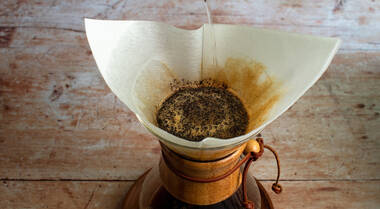
The kettle is poised, the grounds are waiting, and the recipe issues its little command: bloom for 30 seconds. So you pour, watch the coffee swell like a time-lapse forest floor, and wonder whether anything useful is happening. It is. But the stopwatch has acquired more authority than it deserves. A coffee bloom is not an incantation, and 30 seconds is not a sacred interval. It is a practical pause that helps water and coffee begin on better terms.
What the bubbles are telling you
Roasting produces gases inside coffee beans, including carbon dioxide. Some escape after roasting, while some remain trapped within the porous structure of the bean. Grinding dramatically increases the exposed surface area, allowing the gas to leave faster. When hot water reaches freshly ground coffee, the remaining carbon dioxide escapes, creating the swelling, fizzing bed we call the bloom.
That release matters because escaping gas can interfere with even wetting. Water needs consistent contact with the grounds to dissolve the compounds that shape the cup, while carbon dioxide can make that contact less uniform. If you immediately begin a full pour, some grounds may become thoroughly saturated while others remain comparatively dry, encouraging water to find easier paths through the coffee bed. The bloom gives gas an early exit and prepares the grounds for a more uniform extraction.
Thirty seconds is a guideline, not a verdict
The familiar 30-second instruction is useful because it is simple, repeatable, and usually long enough to accomplish meaningful degassing. It is not universally correct. Very fresh coffee may continue expanding beyond 30 seconds, while coffee that has rested longer may produce a modest bloom and settle quickly. Roast development, grind size, storage, and time since roasting all influence what you see.
For a practical starting point, use roughly two to three grams of bloom water for every gram of coffee. A 20-gram dose would receive about 40 to 60 grams of water. Pour slowly across the bed, making sure no obvious dry pockets remain. A gentle swirl can help, especially in a cone brewer. Start timing when the water first touches the grounds, then resume pouring after about 30 to 45 seconds. A
coffee scale and timer makes this easier to repeat without turning breakfast into laboratory theater.
Freshness has a voice, but it does not sing solo
A dramatic bloom often suggests that coffee still contains plenty of gas, but it is not a complete freshness test or a promise of quality. Different coffees can bloom differently even when roasted on the same day. Nor is a towering foam cap automatically better. The useful question is whether the grounds become evenly wet, not whether they deliver Shakespeare in the dripper.
A transparent setup such as the
pour over coffeemaker makes the process easy to observe. Bright, articulate coffees can also make brewing differences easier to taste. The
Monobamba Washed, with sensory notes reminiscent of tangerine, Concord grapes, and currants, is a good candidate for careful pour-over technique. So is the fuller-bodied
Bourbon Washed, whose cup suggests chocolate, sweet graham cracker, and ripe fruit. These notes describe aromas and flavors naturally perceived in the coffee, not added ingredients.
Bloom, pre-infusion, and immersion are not twins
Espresso pre-infusion has a related goal but operates under different conditions. A small amount of water, often at low pressure, wets the compacted puck before full brewing pressure arrives. This can encourage more even saturation and reduce the likelihood that water will find an easy path through the puck. Degassing may occur, but the central concern is preparing a dense, pressurized coffee bed for extraction.
Immersion brewing is different again. In a French press or cupping bowl, the grounds eventually meet the full volume of water and steep within it. A separate bloom is therefore less important than it is in pour-over brewing. Ensuring that all the grounds are thoroughly wetted and breaking up dry clumps is generally more useful than waiting ceremonially over a small preliminary pour.
Necessary, within reason
For pour-over, blooming is more than coffee theater. It supports even saturation and gives trapped gas time to escape before the main extraction begins. Still, the best bloom is responsive rather than doctrinaire. Watch the bed, cover the grounds, swirl gently if needed, and treat 30 seconds as a sensible opening bid. The coffee, not the timer, gets the final word.