
The kettle clicks off. You wait, perhaps because someone once told you boiling water burns coffee, or perhaps because morning has already asked too much. Thirty seconds pass. Is the water now ideal, merely cooler, or participating in an elaborate ritual with no discernible ending?
Water temperature matters, but it is not a moral test. It works alongside grind size, brew time, agitation, coffee dose, and the ratio of coffee to water. The useful question is not, "What is the perfect temperature?" It is, "What temperature helps this coffee and brewer produce the cup I want?"
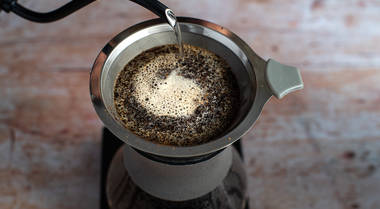
Brewing is extraction: water dissolves soluble material from roasted coffee. Hotter water generally speeds that process, while cooler water slows it. Acids, aromatic compounds, sugars, and bitter-tasting substances do not emerge in a tidy single-file order, but flavor often shifts predictably as extraction changes. Too little extraction can taste sharply sour, thin, or oddly salty. Too much can taste bitter, drying, or hollow.
For most hot brewing methods, 195 to 205 F is a dependable starting range. That is just below the boiling point of water at sea level. Because the boiling point falls as elevation rises, a full boil in a mountain kitchen may already be within the usual brewing range. This is one reason the advice to never use boiling water is less universal than it sounds.
A temperature-controlled smart electric kettle makes experimentation easier. Begin around 200 F, keep every other variable steady, and adjust the temperature by 2 to 5 F at a time. Small, deliberate changes teach you more than chasing a supposedly sacred number.
In pourover brewing, fresh hot water repeatedly meets the grounds, and the temperature can fall as water moves through the brewer. Preheating the dripper and carafe reduces heat loss. Lighter roasts, which are generally less porous than darker roasts, often respond well to water near the upper end of the range. Darker roasts may taste more balanced with slightly cooler water.
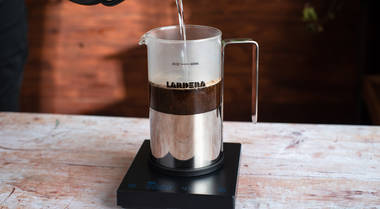
Try a bright washed coffee such as Monobamba Washed at about 200 to 205 F. Its tangerine, grape, and currant notes are sensory characteristics of the coffee, not added flavorings. If the cup seems sour and muted, try hotter water or a finer grind. If it becomes drying, try cooler water or a coarser grind. Resist changing everything at once, however tempting a full kitchen intervention may be.
A French press is an immersion brewer: coffee and water remain together until plunging and pouring. Water around 200 F is a sensible starting point, paired with a coarse, consistent grind and about four minutes of contact. Because the brewer is open and often made of glass, preheating it can help maintain temperature.
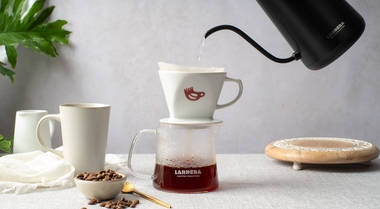
If a press tastes weak, cooler water may be partly responsible, but grind size and coffee-to-water ratio are often stronger suspects. If it tastes harsh, lowering the temperature can help, especially with a dark roast. A finer-than-intended grind or an excessively long steep may be the real culprit, though. Temperature is influential, not omnipotent.
Good automatic drip brewing follows the same principles as pourover, only without requiring you to stand over the counter performing the role of benevolent rain cloud. A brewer such as the Wilfa Performance Coffeemaker handles water delivery consistently, leaving you to focus on fresh coffee, grind size, dose, and clean equipment.
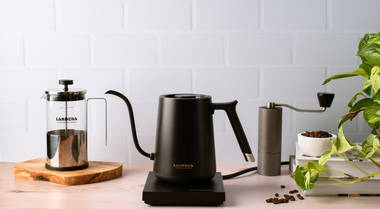
If drip coffee is persistently sour despite a reasonable grind and ratio, water that never becomes hot enough may be the issue. If the first pot tastes lively and later pots become dull or bitter, cleanliness and mineral buildup deserve attention too. Measuring the slurry with a suitable thermometer can help diagnose temperature problems, but avoid touching the filter or brewer walls, which can distort the reading.
Espresso uses pressure, a fine grind, and a short contact time, so a small temperature adjustment can be noticeable. Around 200 F remains a practical starting point. Higher temperatures may increase extraction from a light roast, while slightly lower temperatures can soften roast-driven bitterness in darker coffee. Temperature should follow basic dialing-in, however. First establish a repeatable dose, yield, and shot time. Then adjust the temperature if the flavor still needs refinement.
Cold brew extracts at refrigerator or room temperature over many hours rather than minutes. Cooler water does not stop extraction; it slows the process and changes the balance of the finished drink. The result is not inherently stronger or more caffeinated. Those qualities depend on the coffee-to-water ratio, steep time, dilution, and serving size.
Water temperature is therefore less like Goldilocks finding one perfect bowl and more like a dimmer switch. Start with a sound range, taste carefully, and change one variable at a time. The thermometer supplies the number. Your palate supplies the verdict.