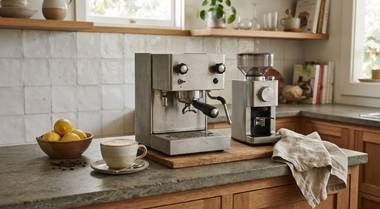
The home espresso machine arrives in the imagination before it arrives in the kitchen. There it stands, gleaming beside a bowl of lemons, producing flawless lattes while its owner wears linen and remembers everyone's birthday. Then comes the payback claim: skip a surprisingly small number of cafe drinks, and the machine has effectively bought itself. Fourteen lattes, perhaps. It is seductive arithmetic. It is also rarely the whole equation.
A home machine can absolutely earn its place. But the honest question is not whether its purchase price equals a handful of cafe tabs. It is whether the complete setup suits your budget, counter space, patience, and preferred morning routine.
The simplest calculation divides the machine price by the price of a cafe latte. That comparison assumes the homemade drink costs nothing and that the machine needs no supporting cast. Neither assumption survives first contact with espresso.
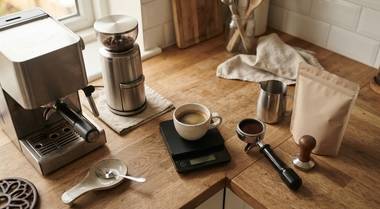
A more useful break-even formula is total setup cost divided by the savings on each drink. Total setup cost includes the machine, a suitable grinder, a scale, and any necessary accessories. Per-drink savings equal what you actually spend at a cafe, including the tip, minus the cost of beans, milk, water, cleaning supplies, maintenance, and the occasional practice shot that goes down the sink during dialing in. Use your own receipts rather than a national average. Your regular order is the only meaningful benchmark.
Fourteen lattes could cover a very inexpensive appliance under unusually generous assumptions. They are unlikely to cover a complete, durable espresso station. This does not make home espresso a bad investment. It merely moves the proposition from fairy tale to household accounting.
Espresso asks water to move through a compact bed of finely ground coffee under pressure. Small changes in grind size can alter the flow dramatically, so a capable, adjustable burr grinder matters. Pre-ground coffee may work with some pressurized baskets, but it offers less control over freshness and extraction.
A precise scale also helps turn mysterious failures into repeatable information. The Coffee Scale and Timer can track both the amount of coffee used and the beverage produced. That may sound clinical, but consistency is liberating. Once a recipe works, you can repeat it without consulting the oracle before breakfast.
Beans belong in the operating budget, not the equipment budget. A coffee designed to remain expressive with milk is a sensible starting point. Lardera's Espresso Roast balances sweetness and complexity with a bright, smooth finish and mild fruit characteristics. Those fruit notes describe sensory qualities of the coffee, not added flavoring.
Making espresso is a compact craft. You will adjust the grind, distribute coffee in the basket, tamp, watch the extraction, steam milk, and clean up. Early drinks may run too quickly, taste harsh, or produce foam with the structural integrity of bath bubbles. The learning curve consumes beans and minutes, both of which belong in an honest audit.
Once learned, however, the process can become the point. There is pleasure in moving from guesswork to fluency, much as there is in learning to bake bread or sharpen a kitchen knife. A cafe sells convenience and hospitality. A home setup offers control, privacy, and repetition. These are different goods, despite arriving in similar cups.
Espresso machines need routine care. Milk residue should be removed promptly, coffee oils accumulate on brewing components, and mineral scale may develop depending on the water and machine design. Follow the manufacturer's instructions for cleaning and water treatment. When compatible with your equipment, Lardera Descaling Tablets can be included in the maintenance budget.
Then audit the kitchen. The machine needs counter space, the grinder needs more, and accessories reproduce in drawers with Victorian-novel enthusiasm. Also consider warm-up time, noise, and whether anyone else will happily learn the routine or regard the machine as your elaborate mechanical pet.
If you buy several milk drinks each week, enjoy hands-on preparation, and expect to keep the equipment for years, home espresso may become economical as well as satisfying. If you drink one latte on Saturday while reading away from home, the cafe is providing atmosphere, skilled labor, and a welcome change of scene. Replacing it may save less than the spreadsheet suggests.
There is also a modest middle path. Strong brewed coffee paired with warmed milk and a Milk Frother will not become espresso, but it can produce a pleasing milk drink without the expense or technical demands of a machine. The best answer is not the one with the shortest alleged payback. It is the ritual you will still enjoy after latte number fourteen.