February 23, 2026
If you've ever poured hot water over fresh coffee grounds and noticed them puff up and bubble, you've witnessed coffee "blooming." For many home brewers, it inspires curiosity (and sometimes confusion). Maybe you've asked yourself if this is supposed to happen, or if something's gone wrong.
In reality, blooming is one of the simplest ways to improve the flavor of your coffee at home.
It doesn't require new beans, advanced techniques, or complicated equipment. Just a small adjustment to your brewing and the payoff is a much more balanced, flavorful cup.
What Is Coffee Blooming?
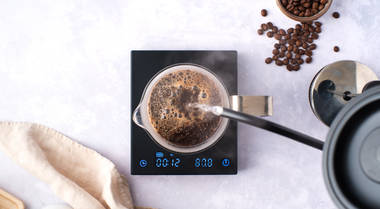
Blooming is the brief step at the beginning of brewing where you add a small amount of hot water to freshly ground coffee and let it sit before continuing the pour. During this time, the coffee releases carbon dioxide (CO₂) that's trapped inside the beans during roasting.
As the gas escapes, the grounds expand and bubble. This is a good sign, since it usually means your coffee is fresh. Allowing this gas to escape before full brewing helps water interact more evenly with the grounds, setting the stage for better extraction.
What's Actually Happening During the Bloom
Freshly roasted coffee contains a surprising amount of CO₂. When you pour water over dry grounds and immediately continue brewing, that gas can repel water and prevent it from fully saturating the coffee. This can mean uneven extraction, where some grounds over-extract while others barely extract at all.
Blooming gives the coffee a head start. By wetting the grounds and waiting 30–45 seconds, you allow excess gas to escape so that the rest of your brew can proceed more evenly. Older coffee won't bloom as dramatically, which is why blooming is especially noticeable with freshly roasted beans.
Why Blooming Improves Flavor
The main benefit of blooming is balance. When water can evenly saturate coffee grounds, extraction becomes more consistent — and that's where flavor clarity comes from.
Skipping the bloom can lead to:
– Sour or sharp notes from under-extracted grounds
– Bitterness from uneven over-extraction
– Muted or muddy flavors
Blooming helps highlight the coffee's natural character, whether that's brightness, sweetness, or depth. It's a small step that often makes the difference between a cup that tastes "fine" and one that inspires a double take after that first sip.
How to Bloom Coffee at Home
Blooming is easy to incorporate into most manual brewing methods. Here's a simple approach that works well for pour-over and French press brewing.
1.
Measure your coffee and water. A common starting ratio is 1:15 to 1:17 (coffee to water by weight). A
Coffee Scale & Timer makes measuring and timing the bloom effortless.
2.
Add just enough water to wet the grounds. Use about 2–3 times the weight of your coffee in water. For example, 20g of coffee = 40–60g of water.
3.
Pour gently and evenly. Aim to saturate all the grounds without flooding them. A
Smart Electric Kettle or controlled-pour kettle helps maintain steady flow and accurate temperature.
4.
Wait 30–45 seconds. Let the coffee bloom fully before continuing the rest of your brew.
5.
Continue brewing as usual. Once the bloom settles, resume pouring the remaining water slowly and evenly.
Does Blooming Matter for Every Brew Method?
Blooming is most impactful for manual brewing methods where you control the pour:
1.
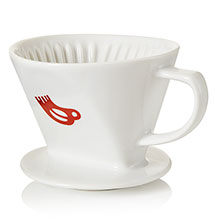
Pour-over: Blooming is essential for even extraction in something like a
Trapezoid Dripper or other manual drippers.
2.
French Press: Blooming helps prevent uneven saturation before stirring.
3.
Automatic drip: Some machines bloom automatically; others benefit from manual pause.
4.
Espresso: Blooming isn't necessary — pressure handles extraction differently.
5.
Cold brew: Blooming isn't needed due to long steep times.
Common Blooming Mistakes to Avoid
Even though blooming is simple, a few small missteps can limit its effectiveness:
–
Using boiling water. Extremely hot water can scorch the grounds, especially with lighter roasts.
–
Not using enough water. Too little water won't fully wet the grounds, trapping gas.
–
Pouring too aggressively. Fast pours can disturb the coffee bed and cause channeling.
–
Skipping the timer. Guessing the bloom time can lead to inconsistent results (which is where a scale with a timer comes in handy).
When Blooming Matters Most
Blooming has the biggest impact when:
– You're using freshly roasted coffee
– Brewing light to medium roasts
– Making pour-over or French press coffee
– Grinding beans just before brewing.
Try a
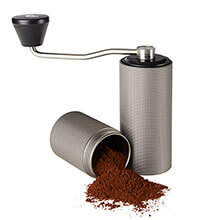
Manual Coffee Grinder or
Electric Coffee Grinder for freshness.
If your coffee blooms dramatically, take it as a good sign. It means your beans are lively and ready to shine!
A Small Adjustment Makes a Big Difference
Blooming coffee is a simple way to add complexity and added nuance to your final brew. With a short pause and a little attention, you give your coffee the chance to extract evenly and express its full range of flavors.
Once you get used to blooming, it quickly becomes second nature. And with the right tools to support precision and control, you can make every cup feel more thoughtful and more rewarding.